E27 vs B22: Light Bulb Bases Explained (and Which One Your Fitting Takes)
Screw or bayonet, big or small: what the codes on a light bulb base mean, which ones Australian homes use, and how to read the rest of the box.
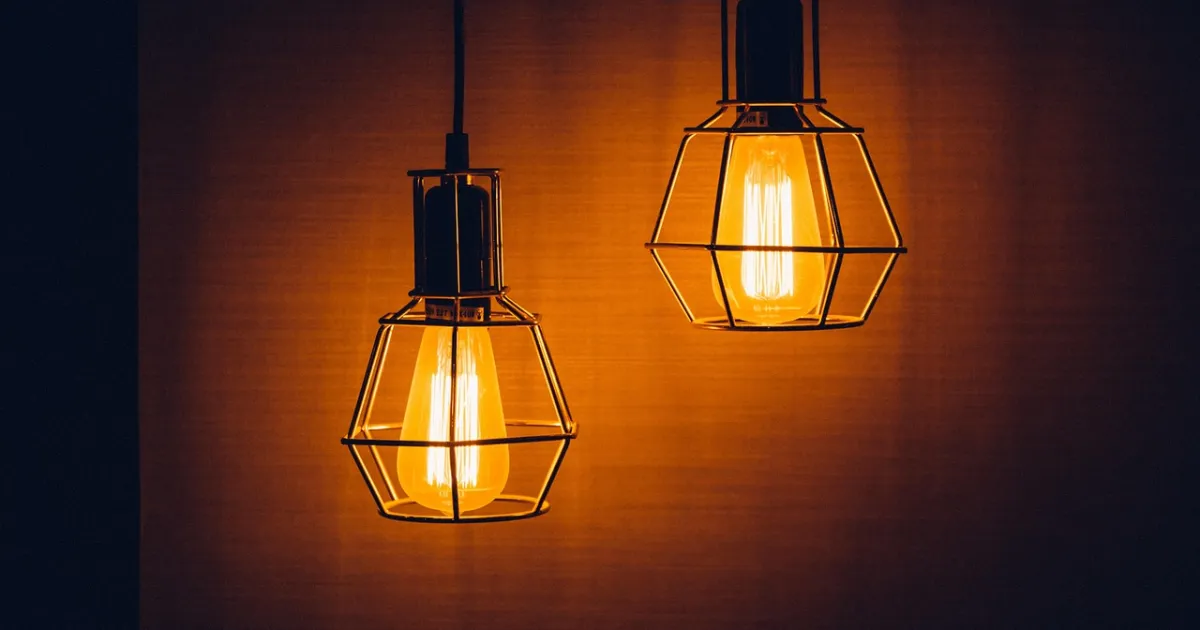
You take a bulb to the shop, find the same-looking bulb on the shelf, get home and it does not fit. The reason is almost always the base: the metal part that goes into the lamp holder. Bases have short codes, and once you know how to read them, buying the right bulb takes seconds.
Reading the code
The letter tells you the type of base and the number gives its diameter in millimetres.
- E stands for Edison screw: a threaded base you screw in. E27 is about 27 mm across the thread.
- B stands for bayonet: a smooth base with two small pins that you push in and twist. B22 is 22 mm across.
- GU is a pin base for small spotlights. In GU10, the two pins are 10 mm apart.
You will also see the common names: ES (Edison screw, E27), SES (small Edison screw, E14), BC (bayonet cap, B22) and SBC (small bayonet cap, B15).
The bases you will meet in Australian homes
| Code | Also called | What it looks like | Where you find it |
|---|---|---|---|
| B22 | BC, bayonet cap | Smooth, two side pins, push and twist | Ceiling battens and many standard fittings |
| E27 | ES, Edison screw | Large screw thread | Pendants, floor and table lamps, especially European designs |
| B15 | SBC, small bayonet | Small smooth base with pins | Small lamps, some wall lights and chandeliers |
| E14 | SES, small Edison screw | Small screw thread | Candle bulbs, chandeliers, small lamps |
| GU10 | - | Two short pins with wide ends, push and twist | Downlights and track spotlights on mains voltage |
The bayonet mount is the standard fitting in the United Kingdom and in many Commonwealth countries, Australia and New Zealand among them, which is why so many older Australian ceilings take B22. Screw bases such as E27 and E14 are the most common in continental Europe and China, and many designer pendants are made for them, so a modern Australian home often has both.
E27 or B22: is one better?
Neither is better at making light: the same LED can be made with either base. The differences are practical:
- Choice of bulbs: decorative filament bulbs (globe, teardrop, tube and spiral shapes) are widely made in E27, and the range in B22 is usually smaller.
- Grip: a bayonet locks in place and does not work loose with vibration; a screw base can be easier to change in an awkward fitting.
- The fitting decides: you cannot choose the base independently of the lamp holder. Buy the bulb to suit the fitting you have.
Adapters from B22 to E27 exist. They make the bulb sit lower in the shade, which can expose it and change how a pendant looks, and the fitting's maximum wattage still applies. If you are changing a fitting anyway, it is simpler to choose one with the base you want.
How to check what your fitting takes
- Switch the light off and let the bulb cool.
- Look at the old bulb's base: thread means E, pins mean B (or GU for a spotlight).
- Measure across the base, or compare it with a 20-cent coin (28.52 mm): an E27 base is just a little smaller; an E14 or B15 base is about half that.
- Check the lamp holder or the fitting's label for a maximum wattage and any note such as "not suitable for dimmers".
The rest of the box: lumens and colour temperature
Once the base is right, two numbers matter more than watts.
Lumens: how much light
Watts measure power used, not light. LED bulbs use far less power for the same light, so compare lumens instead. As a guide, a 60 W incandescent bulb gave about 800 lumens and a 100 W one about 1,600. A decorative filament bulb in a pendant is often much dimmer than that, which is fine for mood light but not for reading.
Colour temperature: warm or cool
Measured in kelvin (K). Lower numbers look warmer and more yellow, higher numbers whiter and bluer.
| Kelvin | Usually sold as | Suits |
|---|---|---|
| 2200–2700 K | Extra warm / warm white | Living rooms, bedrooms, dining, decorative bulbs |
| 3000 K | Warm white | Kitchens and bathrooms that should still feel warm |
| 4000 K | Cool white | Laundries, garages, workspaces |
| 5000–6500 K | Daylight | Task areas where colour matching matters |
Keep one colour temperature within a room. A warm pendant next to cool downlights is one of the quickest ways to make a space feel unplanned.
Dimming
Not every LED bulb dims, and not every dimmer suits LEDs. Look for "dimmable" on the box and check that the dimmer is rated for LED loads; a mismatch shows up as flicker, buzzing or a bulb that will not dim smoothly. Changing a wall dimmer is electrical work for a licensed electrician.
Questions
What is the difference between E27 and B22?
E27 is a 27 mm screw base; B22 is a 22 mm bayonet base that you push in and twist. They are not interchangeable without an adapter.
Which light bulb base is standard in Australia?
The B22 bayonet has long been the standard household base, but E27 screw fittings are very common in modern pendants and lamps, so many homes use both.
What does E14 mean?
A small Edison screw base, 14 mm across, often called SES. It is common on candle bulbs and small lamps.
How many lumens replace a 60 W bulb?
Look for about 800 lumens to match the light of an old 60 W incandescent bulb.